Product walkthroughs

Follow the work.
Check the result yourself.

Commercial and conveyancing examples for Australian boutique firms. These are synthetic evaluation scenarios, not customer stories or measured outcomes. Book a demo, then use a guided 14-day trial to evaluate your own workflow.

Conflict matching currently covers names in Latin script. Record a Latin spelling alongside a name written in another script, and review possible matches before opening a matter.

Inspect MatterFirst usage charges on the matter and across the firm, alongside the documents and signing that follow.

Synthetic example

Conveyancing

Synthetic purchase file: source review, client documents and a signed authority.

Worked source-review exercise

Sample source
Sample contract, page 2: purchase price $850,000; settlement 15 December 2026.
Review exercise
The sample matter record says 16 December. Compare the page citation, correct it to 15 December and confirm the date before the workflow uses it.
Sample client draft after review
We have recorded settlement for 15 December 2026. Please review the attached client authority before signing. A practitioner must review the draft.
Signing check
Use a cost agreement or appropriate authority: review the document, recipients and fields, send the prepared request, then inspect the completed PDF and signing certificate on the matter.
AI charge check
For an illustrative ten-page document, processing consumes A$1.50 of the AI balance, ex GST. Check its matter attribution and itemised export; allowance consumption is not an additional purchase.
  1. Step 1

    Capture and open

    Capture an enquiry, check parties for conflicts and open a purchase matter using the firm's configured template.

    Matter management
  2. Step 2

    Read the source

    Read a sample contract of sale. Inspect the extracted parties, price and dates against their source pages, and the MatterFirst usage charge against this matter.

    Document AI
  3. Step 3

    Review and confirm

    Correct a deliberately mismatched date and confirm the information and obligations before using them for the firm's next actions.

    Source review
  4. Step 4

    Prepare client documents

    Generate and review a client letter from the firm's Word precedent and reviewed matter information. Drafting and substantive review remain separate from signing administration.

    Document preparation
  5. Step 5

    Prepare, send and sign

    Review the cost agreement or client authority, choose recipients and check signing fields. A configured workflow can send the prepared request. Clients sign by secure link or portal; the completed PDF and signing certificate stay on the matter.

    Built-in signing
  6. Step 6

    Keep the client informed

    Share appropriate documents and progress through the client portal. PEXA and InfoTrack are available through coordinated manual setup with MatterFirst and the provider, rather than self-serve. Confirm requirements and timing before rollout.

    Client portal
  7. Step 7

    Review time and costs

    Review recorded time, matter-level AI usage charges and the itemised export. Decide recovery under the applicable rules and costs agreement before billing; recording a charge does not automatically invoice the client.

    AI cost visibility
Synthetic example

Commercial

Synthetic contract review: an engagement agreement, reviewed terms and client advice.

Worked source-review exercise

Sample source
Sample agreement, clause 7: written notice of renewal required 30 days before expiry.
Review exercise
The sample matter record says 14 days. Compare clause 7, correct it to 30 days and confirm the obligation before creating its follow-up.
Sample client draft after review
The agreement requires written renewal notice 30 days before expiry. Please review our advice and the engagement agreement. A practitioner must review the draft.
Signing check
Use a cost agreement or appropriate authority: review the document, recipients and fields, send the prepared request, then inspect the completed PDF and signing certificate on the matter.
AI charge check
For an illustrative ten-page document, processing consumes A$1.50 of the AI balance, ex GST. Check its matter attribution and itemised export; allowance consumption is not an additional purchase.
  1. Step 1

    Open the engagement

    Capture the enquiry, check parties and open a commercial matter with the firm's workflow.

    Lead pipelines
  2. Step 2

    Review the agreement

    Read the sample agreement, inspect extracted terms and citations, and correct an intentionally conflicting value before relying on it.

    Document AI
  3. Step 3

    Prepare the client advice

    Prepare and review a client-facing draft using the matter record and cited sources. A draft is not completed legal advice.

    Document preparation
  4. Step 4

    Sign the engagement

    Check the engagement or cost agreement, recipients and fields, then send its prepared request from the workflow or matter. The client needs no MatterFirst account to use the emailed signing link.

    Built-in signing
  5. Step 5

    Follow the workflow

    Use confirmed information for configured tasks and actions, and share appropriate updates and documents through the portal.

    Automations
  6. Step 6

    Understand AI charges

    Compare the matter's usage charges and work-type breakdown with the firm's AI spend. Export the itemised matter record to support recovery where permitted; included allowance consumption is not an additional purchase.

    AI cost visibility

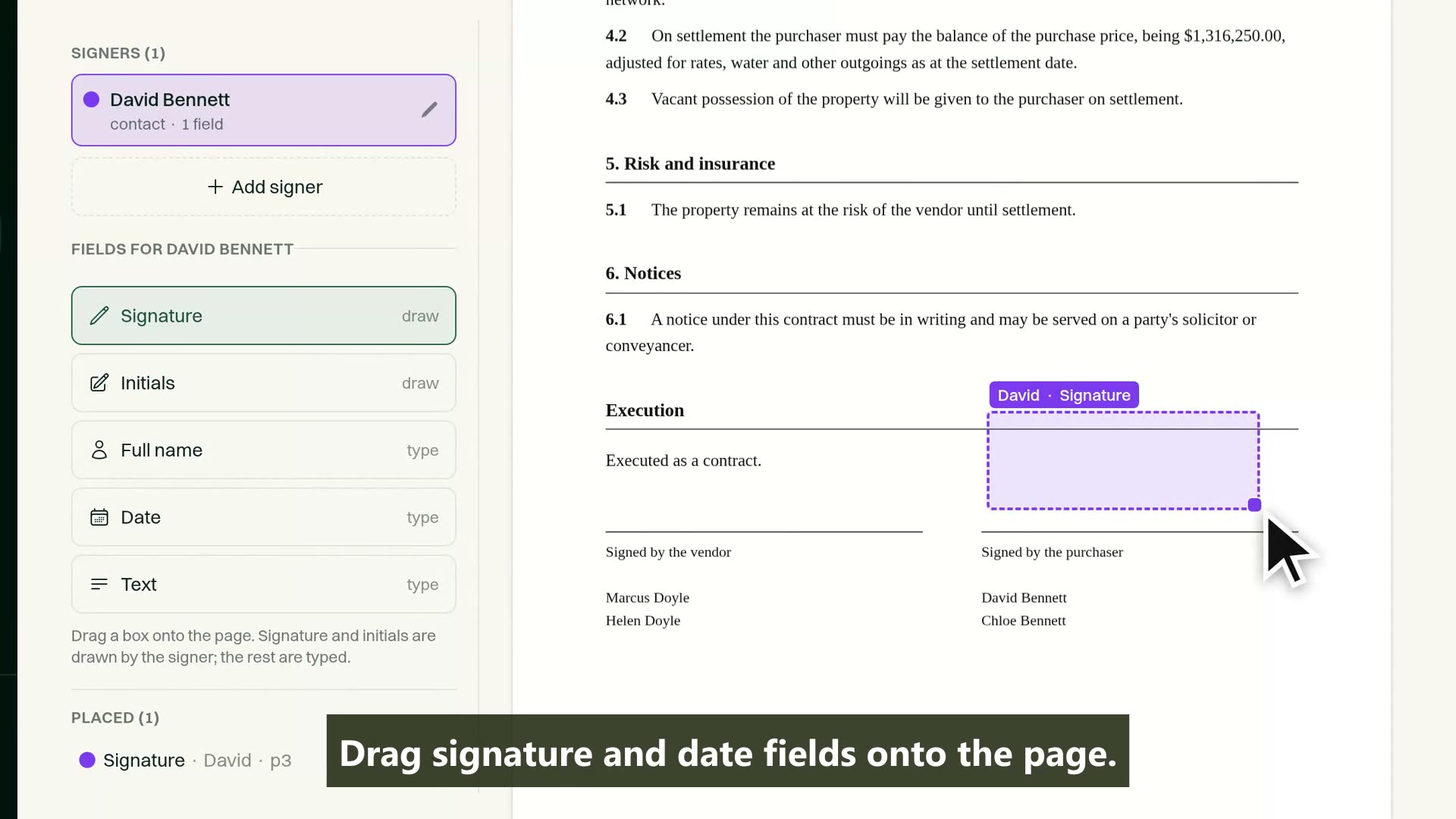
Watch built-in signing

Recorded product example with synthetic data. This clip shows manual recipient and field preparation, secure-link signing and the completed PDF with its signing certificate. It does not demonstrate automated request preparation or confirm suitability for every document.

Sample signing request with recipient and signature fields

Example assumptions

Estimate the administration time you could save

Editable planning estimates, not measured customer averages. Assisted document timings include human review. Administration and document stages exclude signing administration. Signing includes request preparation, sending, status administration and filing; it excludes drafting, substantive review and client waiting time.

The defaults assume one signing request per example matter or document; actual volumes vary. Signing volumes can be changed independently. Saved time is not a promise of billable revenue, client recovery or reduced AI expenditure.

Conveyancing administration
Conveyancing document preparation and review
Conveyancing signing administration
Commercial document administration
Commercial signing administration

Conveyancing: Estimated time saved

18 hours 0 minutes per month

216 hours 0 minutes per year

Includes 4 hours 40 minutes per month of signing administration.

Commercial: Estimated time saved

7 hours 20 minutes per month

88 hours 0 minutes per year

Includes 2 hours 20 minutes per month of signing administration.

Your evaluation scorecard

For each criterion record Pass / Needs work / Not applicable, with evidence and notes. Use your own matter type during the guided trial.

Accuracy and sources
Compare each extracted value with its cited source. Record errors and missing information.
Corrections
Change a conflicting value and check that reviewed matter information is used in subsequent documents and actions.
Review effort
Time staff administration, drafting, substantive review and signing separately. Exclude client waiting time.
Document quality
Check a client-facing draft against your precedent and matter information; record the edits needed before approval.
Signing
Check recipients and fields, send the prepared request, sign through a secure link and inspect the completed PDF and signing certificate.
Workflow fit
Run your own matter type and check approval points, failure handling and integration setup requirements.
AI cost visibility
Inspect firm totals, matter usage charges and work-type details. Export the matter record and distinguish allowance consumption from additional purchased usage.

AI charge records support recovery only where permitted by applicable rules and your costs agreement. They do not establish entitlement or automatically invoice a client.

Download evaluation scorecard

Evaluate your own matter type.

Book a demo, then evaluate with a guided 14-day trial. Scheduled setup and a named contact are available; response arrangements are agreed individually.