Switching from LEAP
Moving off LEAP?
Here is what actually happens.
Not a sales page about how easy it is. The list of what comes across, the list of what does not, who does which part, and the parts that are genuinely awkward for us. Read the second list first.
Last reviewed
Can an Australian law firm move from LEAP to MatterFirst?
Yes. Contacts, matters, documents, time entries, invoices, billing codes and leads import from a CSV export. Templates, court forms, email and calendar history do not, and are rebuilt or reconnected instead. Trust ledger history cannot be imported yet. Most LEAP migrations run four to ten weeks, governed by how quickly the export arrives.
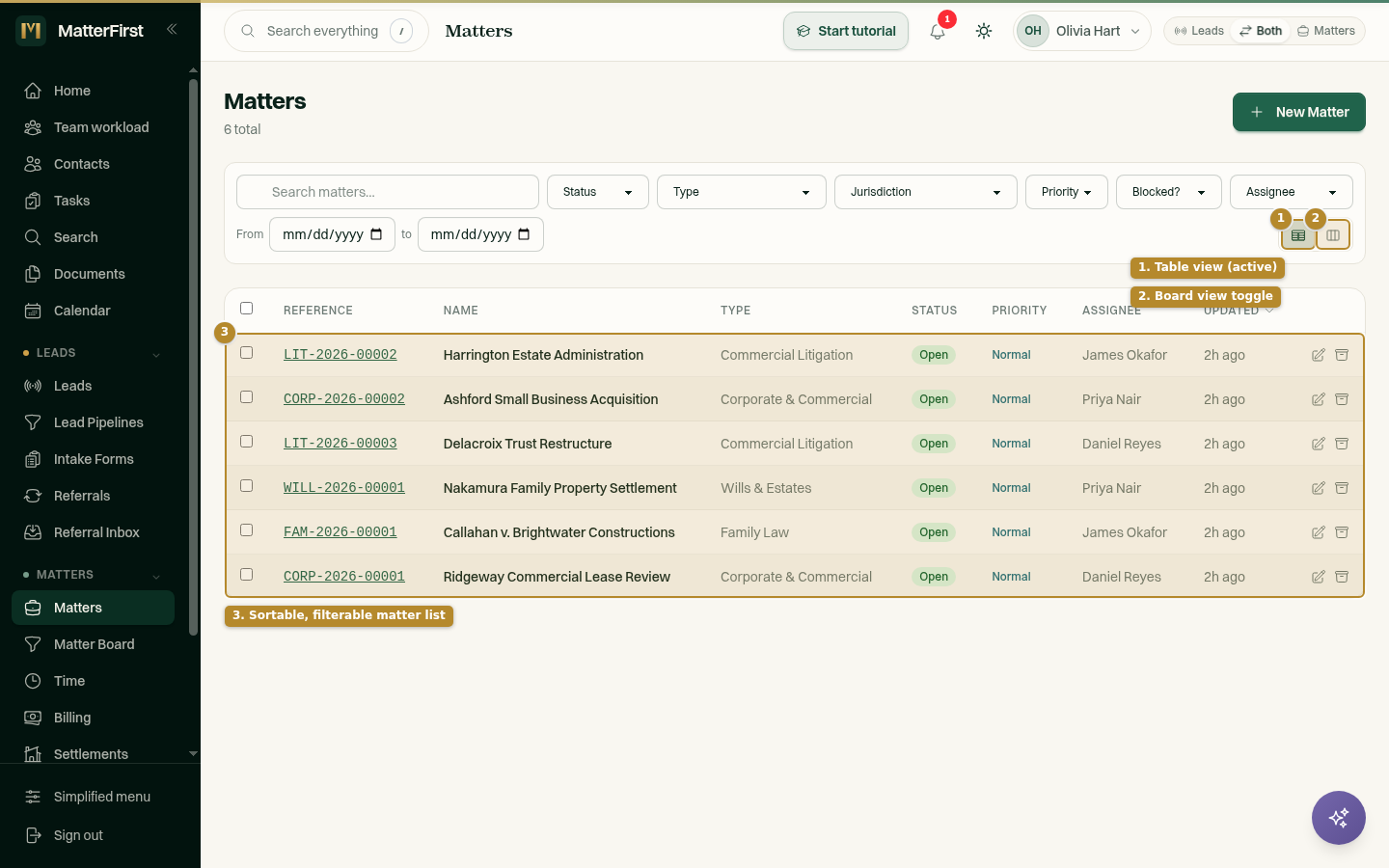
What comes across
Imported automatically.
These are the record types the importer handles from a CSV or LEDES billing files export. It reads from the import pipeline itself, so this list cannot drift away from what the product actually does.
Billing codes and rates
Your rate table, so time entries value correctly rather than needing to be repriced by hand.
Contacts and clients
Names, addresses, phone numbers and email. Duplicates are matched on email and flagged for you to merge rather than silently combined.
Documents
Files and their matter association. Folder structure comes across; version history from the source system generally does not, because most exports do not include it.
Invoices
Issued invoices with their line items and totals, as records. They arrive as history, not as live receivables to re-issue.
Leads and enquiries
Anything in the pipeline that has not become a matter yet, so switching does not cost you the top of the funnel.
Matters
Reference, title, matter type, responsible fee earner, status and open date. Matter types map onto yours during setup, so the structure comes with you.
Time entries
Date, duration, fee earner, matter, rate and narrative. Unbilled time keeps its detail, which is the part that matters for the first invoice after you switch.
Trust ledger history
Every trust transaction per matter, not just closing balances, with your source receipt and payment numbers and their original dates preserved exactly. Reconciled per account and per matter to the cent, and the migration will not complete with an unexplained discrepancy.
What does not come across
The list every vendor leaves out.
Migrations overrun because this list is discovered in week three rather than read in week zero. Most of it is achievable, it is just a person's time rather than a file upload, and it should be quoted rather than assumed. One item is a genuine gap and is marked as such.
Document templates and precedents
Every platform stores merge fields differently, so a template is not a file that can be copied between systems. It has to be rebuilt against MatterFirst's fields.
What we do instead: We rebuild your most-used templates as part of the Migration Package. Firms typically nominate ten to twenty rather than the whole library, because most libraries contain more than the firm still uses.
Automated court forms
LEAP and Smokeball maintain jurisdiction-specific form libraries built over decades. We do not have an equivalent library and will not pretend otherwise.
What we do instead: If automated forms are central to your practice, weigh this seriously before switching. It is the most common honest reason to stay where you are.
Email history
Correspondence usually lives in your mail system rather than your practice management system, and exports are inconsistent between platforms.
What we do instead: Connect Microsoft 365 or Google Workspace, which files mail against matters going forward. Historical mail stays searchable where it already is.
Calendar and diary entries
Same reason. The calendar of record is almost always Outlook or Google, not the practice management system.
What we do instead: Calendar sync is set up during onboarding and runs from that point.
Custom fields with no equivalent
Fields you added to your current system may have no matching field here until one is created.
What we do instead: We map these during scoping. Anything without a home either gets a custom field or is carried as matter notes, and you decide which.
Reports and saved views
Reporting is built on a different data model, so a report definition cannot port.
What we do instead: Tell us the three reports your firm actually runs. Rebuilding those is quick; rebuilding a hundred nobody opens is not worth paying for.
| Stage | Typical duration | What governs it |
|---|---|---|
| Getting the export | 1 to 4 weeks | Entirely dependent on your current vendor and the single most common source of delay. Start this before anything else, including before you have finished deciding. |
| Mapping and staged import | 1 to 2 weeks | Your data lands in a staging area first. We take you through what is there, and nothing is committed until you have signed it off. |
| Templates, matter types and integrations | 1 to 2 weeks | Runs in parallel with the import rather than after it. |
| Parallel running and go live | 1 to 2 weeks | Most firms run both systems briefly. We recommend it: it is cheap insurance and it is how you find the thing nobody thought to check. |
Ranges rather than a single number. A migration quoted at two weeks that takes six is worse than one quoted at four to eight that takes six.
Who does what
Written down, because this is where migrations fail.
The commonest failure is not technical. It is both sides assuming the other was going to request the export.
Your firm
- Requesting the data export from your current vendor, since only the account holder can
- Deciding which matters come across: most firms bring open matters plus a defined window of closed ones rather than everything
- Nominating the templates worth rebuilding
- Checking a sample of imported matters against the source before you go live
MatterFirst
- Mapping your export onto our fields and telling you where it does not fit
- Running the import into a staging area, and taking you through what landed there before anything is committed
- Rebuilding the nominated templates and setting up your matter types
- Configuring integrations: Microsoft 365 or Google Workspace, Xero, Stripe, and PEXA set up with you
Your current vendor
- Producing the export. Timeframes and any fee are theirs to set, and both vary widely
- Confirming what the export does and does not include, which is worth getting in writing
What to ask LEAP for
Be specific, or you will get a PDF.
Firms ask their current vendor for "our data" and receive something unusable, then wait another four weeks for the second attempt. Send this list instead. It is worth doing before you have finished deciding, because the export is the slowest part and it is the part you do not control.
- A full data export in CSV format, covering contacts, matters, time entries, invoices and billing codes
- Documents as files, with a manifest linking each file to its matter reference
- Trust ledger transactions at transaction level, in CSV. We import these and reconcile them per matter to the cent, and you need them for your own seven-year retention obligation regardless of where you go
- Confirmation in writing of what the export excludes
- The date the export can be ready, and any fee LEAP charges to produce it
What it costs
The Migration Package is quoted per firm against your actual export, not sold as a fixed tier.
- The automated import is included in onboarding. Volume does not change that.
- The manual work is what is quoted: template rebuilds, custom field mapping, and anything on the list above.
- We quote after seeing the export, not before. A quote given before anyone has looked at the data is a guess, and the direction it moves is never down.
- Your current vendor may charge for the export itself. Ask them early, because it is their number and not ours.
MatterFirst is a legal practice management platform for Australian law firms, built by NorthCape Technology, covering matters, documents, trust accounting, billing and a client portal, with data hosted in the AWS region the firm chooses.
This guide suits an Australian firm of roughly two to twenty fee earners that has decided to leave LEAP and wants the mechanics before it commits. It will not help a firm that needs its full trust ledger history live in a new system on a fixed date, because our importer cannot do that yet, and it is the wrong page for a firm whose practice depends on an automated court forms library.
Evaluation checklist
Before you commit to leaving LEAP
The questions worth putting to us and to whoever else is on your shortlist, including the ones we answer badly. No form and no email required.
Reviewed by Liam Killingback
Co-founder and Technical Director, NorthCape Technology
Builds the MatterFirst platform. Engineer rather than lawyer, which is why the pages he reviews cite sources instead of asserting legal positions.
Last reviewed
How we check this
- Every claim about another platform comes from that platform's own public documentation or pricing page, linked from the page it appears on.
- Where a vendor does not publish something, the page says 'not published' rather than estimating it. A guess that reads as a fact is the failure mode this rule exists to prevent.
- Every page carries the date its competitor facts were last checked, so you can see how fresh they are rather than assuming.
- We sell one of the products being compared. Every page says so, and every page states the cases where the competitor is the better choice.
- If you find something here that is wrong or out of date, tell us and we will correct it and re-date the page.
FAQ
Questions firms ask before they move
Will we lose our trust ledger history?
How long does moving from LEAP actually take?
Do we have to move every matter?
What does the migration cost?
Can we run both systems for a while?
What if the migration shows MatterFirst is the wrong fit?
Send us your LEAP export and we will tell you what lands
We would rather scope it against your real data than quote against an assumption. If it turns out we are the wrong fit, we will say so.
We can't find the internet
Attempting to reconnect
Something went wrong!
Attempting to reconnect